
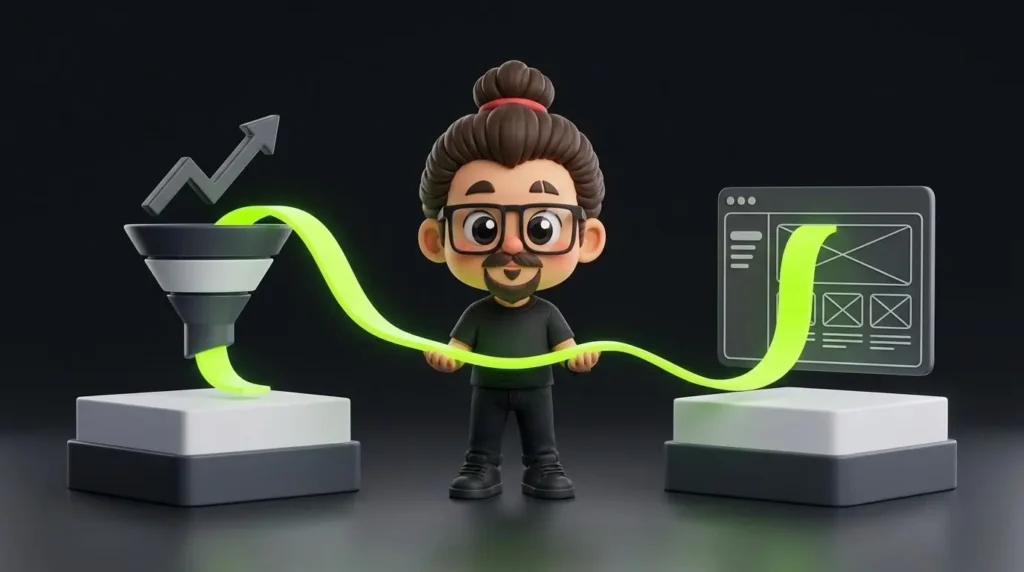
Why Every Product Designer Should Understand Digital Marketing
Introduction
A well-designed product does not automatically become a successful product. People need to discover it, understand its value and have a reason to keep using it.
Traditionally, product designers focused on usability and interfaces, while marketers concentrated on customer acquisition and promotion. But these responsibilities increasingly overlap.
A customer’s journey might begin with a Google search, continue through a landing page and end with regular product usage. Every interaction influences their experience.
This is why I believe every modern product designer should understand digital marketing. Not to become a marketer, but to make better design decisions and understand how products grow.
Let’s explore how these disciplines connect and why marketing knowledge can make product designers more effective.
Table of Contents
Understanding the Connection Between Product Design and Marketing
The User Experience Begins Before the Product
Why Designers Should Understand Business Metrics
How Marketing Knowledge Improves Product Design
Why Growth Is Part of Product Design
Essential Digital Marketing Skills for Product Designers
How to Get Started
Conclusion
Frequently Asked Questions
Understanding the Connection Between Product Design and Digital Marketing
Product design focuses on understanding users and creating meaningful experiences. Digital marketing focuses on attracting audiences, communicating value and encouraging action.
Although their responsibilities differ, both influence the same customer journey.
Consider someone searching for project management software. They discover a product through Google, visit its website, explore its features and sign up for a free trial.
Their experience involves several touchpoints:
SEO helps them discover the product.
Content marketing helps them understand its value.
Landing page design encourages registration.
Product design shapes their onboarding experience.
Email marketing supports engagement.
Product experience influences retention.
A problem at any stage can affect the overall outcome.
For example, an advertisement might attract potential customers, but a confusing landing page can prevent them from signing up. Similarly, an excellent onboarding experience cannot compensate for misleading marketing promises.
Understanding this connection helps designers look beyond individual interfaces and consider the complete customer journey.
The User Experience Begins Before the Product
One common misconception in product design is that the user experience begins when someone opens an application.
In reality, it starts much earlier.
A potential customer might first encounter a product through a search result, social media advertisement, blog article or recommendation.
These interactions create expectations before users experience the actual product.
Marketing Shapes User Expectations
Imagine a company promoting its application as simple and easy to use.
After registering, users encounter a complicated onboarding process with unnecessary steps. The experience contradicts the original promise.
This creates a gap between customer expectations and product reality.
Designers should understand how marketing communicates product benefits and ensure that the actual experience delivers on those promises.
Every Touchpoint Matters
Landing pages, advertisements, onboarding flows and email communication are connected parts of the customer experience.
For example, someone clicking an advertisement about a specific product feature should be able to find relevant information about that feature on the landing page.
The same promise should continue into the product experience.
The takeaway: Understanding marketing helps designers create consistent experiences across discovery, acquisition and product usage.
Why Product Designers Should Understand Business Metrics
Designers often evaluate their work through usability, accessibility and user feedback. These are essential, but understanding business metrics provides another perspective.
It helps connect design decisions with measurable outcomes.
Here are some important metrics every product designer should recognise.
| Metric | What It Measures |
|---|---|
| Customer Acquisition Cost (CAC) | Average cost of acquiring a customer |
| Conversion Rate | Percentage of users completing a desired action |
| Click-Through Rate (CTR) | Percentage of people clicking a link or advertisement |
| Activation Rate | Percentage of new users reaching an important product milestone |
| Retention Rate | Percentage of users continuing to use a product |
| Customer Lifetime Value (LTV) | Estimated value generated by a customer over time |
| Return on Advertising Spend (ROAS) | Revenue generated relative to advertising expenditure |
Consider an e-commerce application.
A clearer landing page may improve conversion. A simpler checkout process may reduce abandonment. A better post-purchase experience may encourage repeat purchases.
Designers do not need to own every business metric, but understanding them helps explain why certain design decisions matter.
Instead of asking only whether an interface looks good, designers can also ask whether it helps users and the business achieve their goals.
How Digital Marketing Knowledge Improves Product Design
Marketing knowledge can influence several everyday design decisions.
1. Better Understanding of User Intent
SEO and customer research reveal what people are searching for and the problems they want to solve.
Someone searching for “best project management software for small teams” is exploring solutions. Someone searching for “how to invite team members” may already be using a product.
Understanding these differences helps designers create more relevant navigation, content and experiences.
2. More Effective Landing Pages
Landing pages are not just marketing assets. They are important parts of the user experience.
Understanding conversion principles helps designers improve value propositions, information hierarchy, calls to action, trust signals and form interactions.
The goal is to help visitors understand what the product offers and what they should do next.
3. Better Onboarding and Retention
Getting users to register is only the beginning.
Designers must also help them experience the product’s value.
A complicated onboarding process can discourage new users before they discover the features that make the product useful.
Understanding activation and retention helps designers focus on reducing friction and encouraging meaningful product engagement.
4. More Informed Design Decisions
Marketing analytics and experimentation provide insights into customer behaviour.
Designers can use these insights to investigate problems, develop hypotheses and test alternative solutions.
For example, if visitors frequently abandon a registration form, designers can investigate whether its length, unclear instructions or unnecessary information requirements contribute to the problem.
Why Growth Is Part of Product Design
Growth should not be treated as something that happens only after a product launches.
Product decisions influence how easily people discover value, adopt features and continue using a product.
One useful framework for understanding growth is the AARRR model:
Acquisition: How people discover the product.
Activation: How users experience its initial value.
Retention: What encourages them to return.
Referral: What motivates users to recommend it.
Revenue: How the product generates income.
Each stage presents design opportunities.
For example, a designer working on a collaboration application might improve its landing page, simplify onboarding, make team invitations easier and improve recurring workflows.
These decisions influence different stages of the customer journey.
This does not mean designers must own the entire growth strategy. It means understanding how their work contributes to product adoption and business performance.
Essential Digital Marketing Skills for Product Designers
You do not need to become an expert in every marketing discipline. However, understanding a few fundamentals can make you a stronger product designer.
Search Engine Optimisation (SEO): Understand search intent, keyword research and information discoverability.
Content Marketing: Learn how businesses attract and educate audiences through useful content.
Conversion Rate Optimisation (CRO): Understand how design influences user actions and conversion.
Performance Marketing: Learn how advertising campaigns, landing pages and audience targeting work together.
Marketing Analytics: Develop the ability to interpret traffic, engagement and conversion data.
Customer Journey Mapping: Understand how people interact with a business across different stages.
These skills help designers connect user needs with business objectives.
How Product Designers Can Get Started
You do not need to change your career or become a full-time marketer to develop these capabilities.
Start with a few practical steps.
1. Learn the fundamentals.
Understand SEO, content marketing, conversion optimisation, advertising and marketing analytics. Focus on how each discipline contributes to customer acquisition and retention.
2. Study products you use.
Explore their websites, landing pages, onboarding experiences and marketing communication. Observe how they attract customers and communicate their value.
3. Connect design decisions with metrics.
In your next project, identify the business objective behind the design. If you are improving registration, understand whether the goal is increasing sign-ups or reducing abandonment.
4. Collaborate with marketing teams.
Learn about their campaign objectives, customer insights and acquisition challenges. Share your product research and usability findings in return.
5. Apply your knowledge.
Choose a website or product journey and evaluate it from both UX and marketing perspectives. Identify where users experience friction and suggest improvements.
Conclusion
Product design and digital marketing are complementary disciplines that influence different stages of the same customer journey.
Product design helps people interact with products and achieve their goals. Digital marketing helps people discover those products, understand their value and make informed decisions.
Understanding both gives designers a broader perspective.
You do not need to become a marketer. You need to understand how people discover products, what influences their decisions and how design contributes to business outcomes.
Because designing a good product is important. Understanding how people discover it, experience it and continue using it is equally important.