
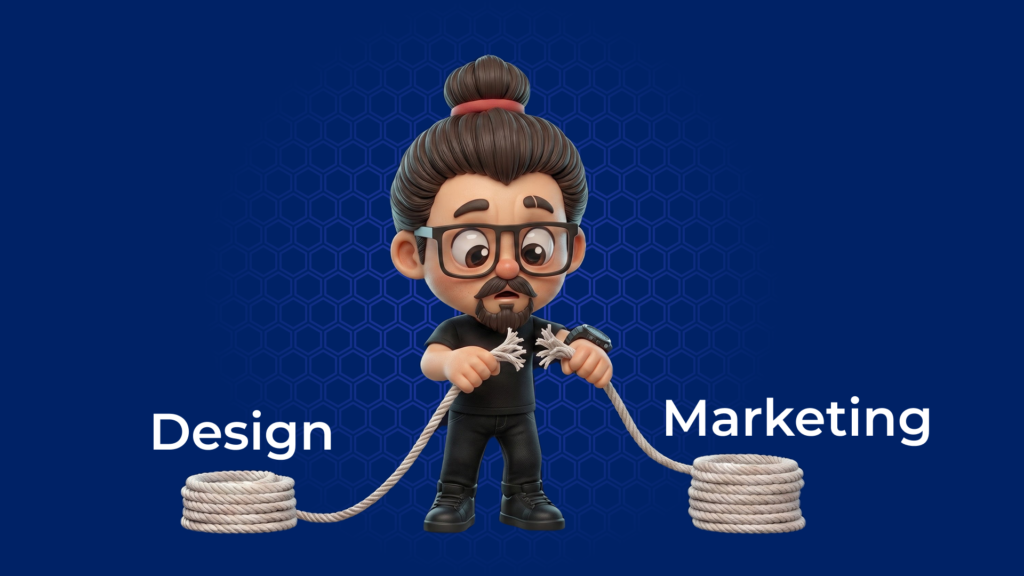
Why Every Product Designer Should Understand Digital Marketing
Designing a great product is only half the challenge.
The other half is ensuring people discover it, understand its value, and continue using it.
For years, product design and digital marketing have been treated as separate disciplines. Designers focused on usability, while marketers focused on acquisition. But in today’s digital landscape, that separation is becoming increasingly difficult to justify.
The best digital products aren’t built by isolated teams, they’re built by people who understand the entire customer journey, from the first advertisement a user sees to the moment they become a loyal advocate.
That’s why I believe every modern Product Designer should understand digital marketing.
Not to become a marketer, but to become a better designer.
Product Experience Starts Before the Product
One of the biggest misconceptions in product design is that the user experience begins when someone opens the app or visits the website.
In reality, the experience starts much earlier.
A potential customer might first encounter your product through a Google search, a LinkedIn post, an Instagram advertisement, a YouTube video, or a recommendation from a friend. Before they interact with your interface, they’ve already formed expectations based on your messaging, branding, visuals, and value proposition.
If the promise made by marketing doesn’t match the experience delivered by the product, trust begins to erode.
That’s why product designers shouldn’t ignore the acquisition stage. Understanding how users arrive at a product provides valuable context for designing experiences that feel consistent, relevant, and trustworthy.
Design Doesn’t End at the Interface
Traditional product design often focuses on user flows, navigation, wireframes, and usability.
Those are essential skills.
But products don’t succeed because they have beautiful interfaces.
They succeed because people discover them, understand them, adopt them, and continue returning.
This is where digital marketing and product design naturally overlap.
A landing page isn’t just a marketing asset—it’s the first step of the user experience.
An onboarding flow isn’t only a UX challenge—it directly influences activation and conversion.
An email sequence isn’t just communication—it shapes user engagement and retention.
Designing these touchpoints requires an understanding of both user behaviour and marketing strategy.
The Language of Business Is Metrics
One of the biggest shifts in my own thinking came when I stopped evaluating design solely through usability and started evaluating it through business outcomes.
A successful design isn’t simply one that looks clean or feels intuitive.
It’s one that helps achieve measurable goals.
Digital marketing introduces product designers to metrics that reflect real business performance, including:
- Customer Acquisition Cost (CAC)
- Conversion Rate
- Click-Through Rate (CTR)
- Activation Rate
- Retention Rate
- Customer Lifetime Value (LTV)
- Return on Advertising Spend (ROAS)
You don’t need to become a performance marketer to understand these metrics.
But understanding what they represent allows you to make more informed design decisions.
Instead of asking, “Does this interface look good?”, you begin asking, “Does this help users take the next step?”
That shift fundamentally changes how products are designed.
Better Collaboration Creates Better Products
In many organisations, marketing and product teams operate independently.
Marketing campaigns promise one thing.
The product delivers another.
Support teams handle the confusion.
When designers understand digital marketing, they become an important bridge between these teams.
They can ensure messaging aligns with product functionality, landing pages reflect actual product value, onboarding reinforces campaign expectations, and user journeys remain consistent across every touchpoint.
This alignment doesn’t just improve user satisfaction.
It reduces friction, improves conversion, and strengthens brand trust.
Growth Is Part of Product Design
Growth isn’t something that happens after launch.
It’s something products should be designed for from the beginning.
A designer who understands growth thinks differently.
Instead of asking:
“How do I design this feature?”
They ask:
- How will users discover it?
- What motivates them to try it?
- What encourages them to return?
- Where might they abandon the journey?
- How can we reduce friction?
- What behaviour are we trying to influence?
These questions connect UX design with business strategy.
Design becomes less about screens and more about outcomes.
The Modern Product Designer Wears More Than One Hat
The role of a Product Designer has evolved significantly over the last decade.
Today, we’re expected to contribute to research, product strategy, design systems, accessibility, analytics, experimentation, AI, and increasingly, growth.
Understanding digital marketing doesn’t mean replacing a marketing team.
It means becoming a stronger collaborator.
It allows designers to speak the language of acquisition, conversion, and retention while continuing to advocate for users.
That combination creates immense value, particularly in startups and product-led organisations where every design decision influences business performance.
Final Thoughts
The best products don’t grow because they have exceptional interfaces alone.
They grow because every stage of the customer journey works together—from awareness and acquisition to activation, engagement, retention, and advocacy.
Product design and digital marketing are not competing disciplines. They’re complementary parts of the same experience.
As designers, our responsibility extends beyond creating intuitive interfaces. We help shape how people discover products, what they expect before using them, how they experience them, and why they choose to stay.
The more we understand the complete journey, the better products we build.
Because in the end, successful products aren’t just well-designed.
They’re well-positioned, well-communicated, and designed to grow.